An evaporative cooler can cool a home efficiently when the outdoor air is hot and dry. It uses water evaporation instead of a refrigerant compressor. That difference makes climate and humidity critical when deciding whether one suits your home.
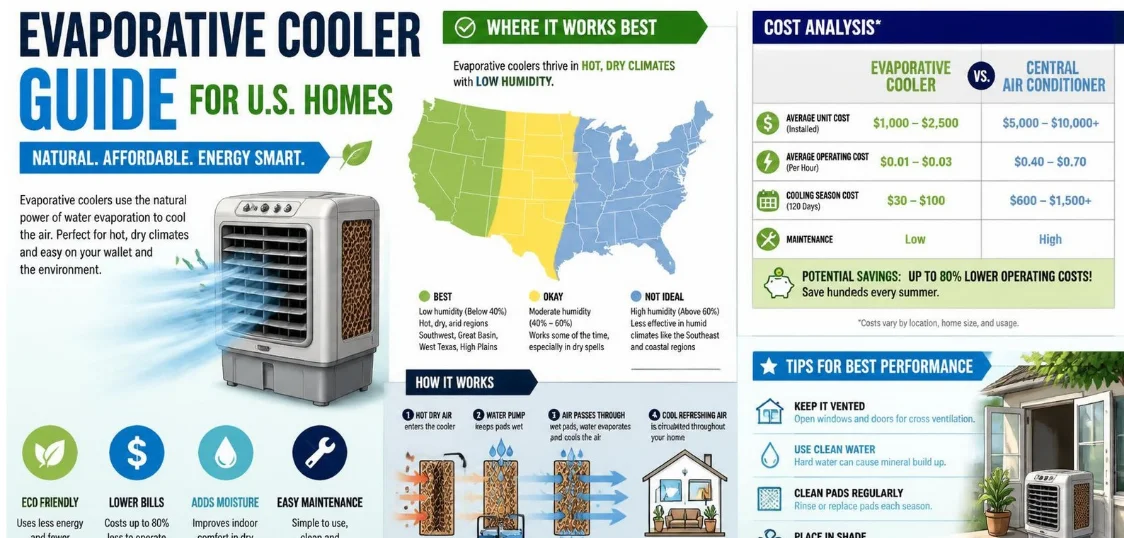
Quick answer: An evaporative cooler pulls warm outdoor air through wet cooling pads, where evaporation removes heat. The system then pushes cooler, more humid air indoors while warmer indoor air exits through open windows or vents. It works best in dry parts of the United States.
Evaporative Cooling at a Glance
| Question | Practical answer |
|---|---|
| Best climate | Hot, dry or semi-arid areas |
| Poor climate fit | Humid coastal and southeastern regions |
| Main cooling method | Water evaporation |
| Refrigerant required | No |
| Adds indoor moisture | Direct systems do |
| Ventilation required | Yes, for most direct systems |
| Common types | Portable, window, roof, direct, indirect, two-stage |
| Main maintenance | Pads, pump, water reservoir, scale and seasonal cleaning |
| Key buying measure | Airflow, usually listed in CFM |
| Main tradeoff | Lower electricity demand but ongoing water use |
Key Takeaways
- Dry outdoor air gives evaporative cooling its strongest temperature drop.
- High humidity reduces evaporation and limits useful cooling.
- Direct systems normally require an open window or another exhaust path.
- Whole-house, window, and portable models serve different spaces.
- Mineral buildup can shorten pad and pump life without regular maintenance.
- Traditional air conditioning remains more dependable in humid U.S. climates.
What Is an Evaporative Cooler?

The system uses the natural heat-absorbing effect of water changing into vapor. A fan draws warm outside air across saturated cooling pads. Part of the water evaporates, reducing the temperature of the moving air.
The cooled air then enters the living space through a grille or duct system. Direct models also add moisture to that incoming air. This added humidity can feel comfortable in arid regions but troublesome elsewhere.
This process differs greatly from conventional refrigerated air conditioning. Central AC circulates refrigerant through a compressor, coils, and other components. HausFixr’s guide to the AC condenser explains that conventional heat-transfer process in more detail.
How Does an Evaporative Cooler Work?
A typical unit contains a fan or blower, cooling pads, a pump, and a water reservoir. The pump keeps the cooling media wet while the fan moves outdoor air across it. Evaporation absorbs heat from that airflow before it enters your home.
The U.S. Department of Energy describes evaporative systems as particularly suitable for dry regions. Direct units send the cooled, moisture-added air into the home. Indirect models use a heat exchanger and can reduce temperature without adding the same indoor moisture.
The process needs steady airflow through the building. Warm indoor air must have somewhere to escape as cooled outdoor air enters. Closing every window can reduce performance and allow excessive humidity to build.
Where Evaporative Cooling Works Best in the United States
Climate is the most important factor in the buying decision. These systems are strongest across dry sections of the Southwest and Mountain West. Arizona, New Mexico, Nevada, Utah, and parts of Colorado are common examples.
Performance becomes less predictable as outdoor humidity rises. Moist air cannot absorb additional water as readily as dry air. That leaves less evaporation available to remove heat.
Homes across humid Gulf Coast and southeastern states usually need refrigerated air conditioning instead. Places such as Houston, New Orleans, Miami, and much of Florida commonly experience high summer humidity. Conventional cooling also removes indoor moisture, which evaporative systems cannot do effectively.
Evaporative Cooler vs. Air Conditioner
These two technologies solve the same comfort problem in different ways. Neither option is automatically better for every U.S. homeowner. Local humidity, water availability, temperature, and desired indoor control should guide the decision.
| Feature | Evaporative cooling | Traditional air conditioning |
|---|---|---|
| Cooling process | Water evaporation | Refrigerant cycle |
| Best conditions | Hot and dry | Nearly all climates |
| Indoor humidity | Usually increases | Usually decreases |
| Fresh outdoor air | Constant supply | Usually recirculates indoor air |
| Compressor | No | Yes |
| Water use | Yes | Usually minimal |
| Open window needed | Often | No |
| Temperature control | Climate dependent | More consistent |
| Maintenance focus | Pads, water and scale | Filters, coils and refrigerant system |
If your existing AC runs without cooling properly, don’t assume another cooling technology is necessary. Several airflow or equipment problems can create the same symptom. HausFixr’s AC running but not cooling guide covers the checks worth making first.
Direct, Indirect, and Two-Stage Designs
Direct evaporative systems are the simplest and most common residential design. Outside air passes through wet media before entering the building. The process lowers temperature while increasing humidity.
Indirect models separate the evaporative process from the supply air with a heat exchanger. Indoor supply air therefore gains less moisture. These systems can improve comfort where direct cooling would add too much humidity.
Two-stage designs combine indirect and direct cooling. They first lower air temperature without substantial moisture addition. A second stage then provides additional evaporative cooling under suitable conditions.
Portable, Window, or Whole-House?
Portable units make sense for patios, workshops, garages, and selected indoor spaces. Their advertised coverage depends on airflow and surrounding conditions. A small personal model cannot provide the same result as a large whole-house system.
Window models pull outdoor air directly into a room. Larger roof or wall-mounted units can supply several rooms through ductwork. Current U.S. retailer listings include residential models ranging from small personal units to systems moving several thousand CFM.
Choose capacity based on actual airflow requirements rather than cabinet size alone. A larger number is not always the right answer. Excess airflow, poor venting, or unsuitable humidity can still produce disappointing comfort.
For more cooling and appliance guidance, HausFixr maintains a broader collection of home appliance guides. Comparing technologies before buying can prevent an expensive climate mismatch.
How Much Electricity Can It Save?
Evaporative cooling avoids the energy-intensive compressor used by conventional refrigerated systems. Most electrical demand comes from the blower and water pump. That basic design can produce substantial electricity savings under favorable conditions.
Actual savings depend on weather, system size, operating hours, local utility rates, and the equipment being replaced. A small portable model and a ducted whole-house unit should not be compared as equals. The home’s insulation and solar exposure also affect total cooling demand.
Lower electrical demand does not mean zero operating cost. These systems consume water while running. Pump replacement, pads, cleaning, and seasonal service should also be included in ownership costs.
How Much Water Does It Use?
Water consumption changes with airflow, temperature, humidity, pad design, and mineral-management settings. More evaporation generally means more water consumption. Some systems also discharge water intentionally to control mineral concentration.
That tradeoff matters in drought-prone western states. Homeowners should compare expected water demand against local prices and restrictions. Efficient operation requires balancing water use with cooling performance.
Hard water can also leave mineral deposits on pads and internal components. Scale reduces water distribution and airflow over time. If mineral buildup is common in your home, HausFixr’s water softener installation cost guide explains another household water-treatment option.
Why Open Windows Matter
A direct system continually introduces outside air into the home. That incoming volume must push an equal amount of indoor air somewhere else. Slightly opened windows or dedicated exhaust vents provide that path.
Opening the correct windows can also help direct cool airflow through occupied rooms. Too little exhaust causes pressure and humidity problems. Excessive opening can allow unnecessary hot air into areas the system is trying to cool.
EPA guidance also highlights an important outdoor-air concern. These systems bring substantial amounts of outside air indoors. Avoid operating one during poor outdoor air quality unless suitable filtration and operating guidance address that condition.
Maintenance That Keeps the System Working
Inspect cooling pads regularly during the operating season. Replace or clean them according to the manufacturer’s instructions. Mineral deposits, dust, and damaged media can reduce airflow and evaporation.
The reservoir and water-distribution system also need attention. Sediment or biological growth should not remain in standing water. Pumps and distribution lines must deliver water evenly across the pads.
Seasonal systems usually need startup and shutdown service. Drain and clean the unit before winter where freezing is possible. Follow manufacturer instructions for winter covers, water lines, and pad storage.
Is an Evaporative Cooler Right for Your Home?
Start with your local summer humidity rather than the purchase price. A dry-climate homeowner can gain efficient cooling and steady fresh-air movement. A humid-climate homeowner may get little temperature reduction and unwanted indoor moisture.
Next, decide whether you need spot cooling or whole-house comfort. Portable equipment works differently from a permanently installed roof or window system. Match airflow, space size, electrical requirements, ventilation, and water access before buying.
Finally, compare the total operating picture. Include electricity, water, maintenance, installation, and expected comfort. Choosing the right technology for your climate usually matters more than choosing the cheapest unit.
The Bottom Line for U.S. Homeowners
Evaporative cooling can be an excellent match for hot, arid regions. It offers simple mechanical operation, fresh-air movement, and potentially lower electricity use. Those advantages depend heavily on keeping humidity low and maintaining the water system.
Don’t choose one based on a product’s coverage claim alone. Check local summer humidity, airflow needs, water conditions, ventilation, and installation requirements. When those factors align, this cooling method can provide comfortable relief without a conventional compressor.
Frequently Asked Questions
Do evaporative coolers really cool a room?
Yes, under suitable dry conditions. Water evaporation removes heat from incoming air, allowing the system to deliver cooler air. The effect becomes weaker as outdoor humidity rises.
Does an evaporative cooler need an open window?
Most direct systems need an exhaust path. A slightly opened window or purpose-built vent allows warm indoor air to leave. The manufacturer’s ventilation instructions should determine the correct opening area.
Do these coolers work in humid climates?
Performance usually drops considerably in humid weather. Moist air already contains substantial water vapor, leaving less capacity for evaporation. Conventional air conditioning is generally more practical in humid U.S. regions.
Is evaporative cooling cheaper than air conditioning?
It can cost less to operate in a suitable dry climate because it does not use a refrigeration compressor. Savings vary by electricity rates, system size, weather, and operating hours. Water and maintenance costs still belong in the comparison.
What is another name for an evaporative cooler?
“Swamp cooler” is the most common alternative name in the United States. The nickname can be misleading because the equipment performs best in dry conditions. True swamp-like humidity works against the cooling process.
Can I run one with all the windows closed?
That is usually a poor operating method for a direct system. Incoming air needs a planned exit route through windows or dedicated vents. Follow the equipment manufacturer’s ventilation requirements for safe and effective operation.