
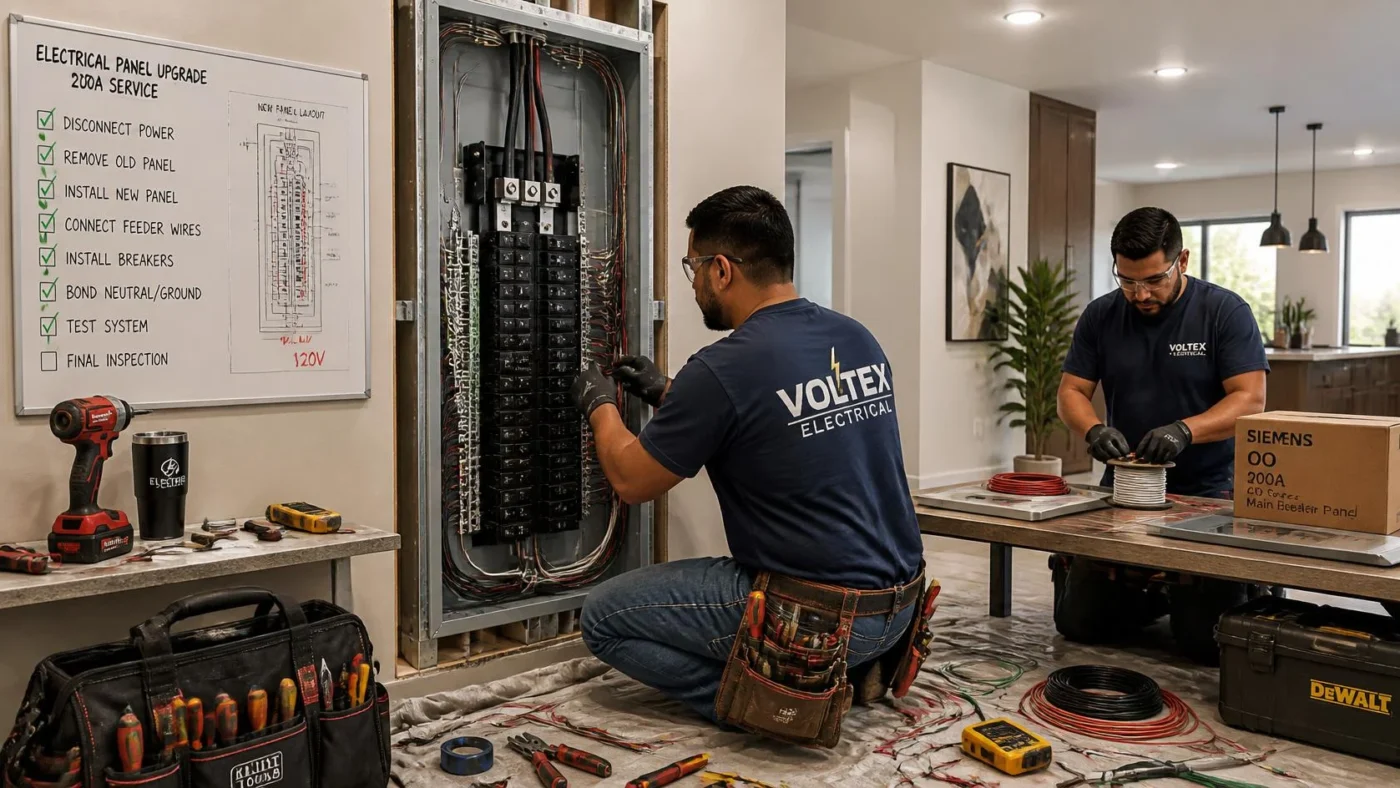
An electrical panel upgrade can give your home more capacity, safer equipment, and room for future circuits. You may need one before adding an EV charger, heat pump, or other high-demand equipment. Still, not every older or crowded panel needs a 200-amp service.
Quick answer: Most U.S. homeowners should consider upgrading when the existing service lacks capacity, the equipment is damaged, or planned appliances need more power. A typical project can cost roughly $1,200 to $4,000, though a full service upgrade may cost more. A licensed electrician should confirm the required size through a load calculation.
| Key question | Practical answer |
|---|---|
| Typical 2026 cost | Roughly $1,200–$4,000 for many projects |
| Common upgrade | 100-amp to 200-amp service |
| Installation time | Often about 4–8 hours onsite |
| Permit needed? | Usually yes, subject to local rules |
| DIY project? | No; service equipment can remain dangerously energized |
| Does every 100A home need 200A? | No; load calculations and future needs matter |
| Federal tax credit in 2026? | The previous panel tax credit ended December 31, 2025 |
| Other incentives | State and utility rebates may still be available |
Key Takeaways
- A larger service isn’t automatically necessary just because a panel is old or full.
- A licensed electrician should calculate demand before recommending a service size.
- Current national cost guides commonly place many upgrades between about $1,200 and $4,000.
- Meter work, service conductors, panel relocation, and utility changes can raise the price.
- A straightforward installation often takes one workday, while permits can extend the calendar timeline.
- The federal tax credit previously available for qualifying panel work ended after December 31, 2025.
- Some households may qualify for state, local, or utility incentives instead.
How Much Does an Electrical Panel Upgrade Cost in 2026?
Current U.S. pricing varies because contractors use the term “upgrade” for several different jobs. This Old House reports an overall range of about $800 to $4,000. It places many 200-amp upgrades around $1,300 to $3,000.
Angi reports a narrower professional range of about $1,200 to $2,000. Other 2026 guides place full 100A-to-200A service work closer to $3,000 to $6,000. The difference usually comes from what each estimate includes.
| Project type | 2026 planning range | What changes the price |
|---|---|---|
| Same-capacity panel replacement | About $1,200–$3,000 | Breakers, labor, permits, access |
| Standard 200A upgrade | About $1,300–$4,000 | Existing service equipment and wiring |
| Full service upgrade | Often $3,000–$6,000+ | Meter, conductors, mast, utility work |
| Panel relocation | Usually higher | New cable routes and wall repairs |
| Higher-capacity service | Quote dependent | Utility capacity and larger equipment |
Treat these numbers as budgeting ranges, not contractor bids. Local labor, permit fees, utility requirements, and equipment availability change the final price. Ask contractors to quote the same scope before comparing totals.
What Does the Electrical Panel Upgrade Usually Include?

Planning an Electrical Panel Upgrade requires a systematic approach to ensure your home’s electrical system safely supports modern energy demands without unnecessary expenses.
The work may include the new panel, compatible breakers, grounding changes, labeling, permits, and inspection. A larger service can also require meter or service-entrance changes. Utility coordination becomes especially important when the incoming service must change.
Panel space and service capacity are also different issues. A full breaker box can sometimes be addressed without increasing service amperage. ENERGY STAR recommends having a licensed electrician review capacity and planned electric appliances before deciding.
Signs Your Home May Need More Capacity
Repeated electrical problems deserve investigation, though they don’t always mean the service is undersized. Frequent breaker trips, overheated components, damaged equipment, and limited circuit space can justify a professional evaluation. Planned high-demand equipment can also change the calculation.
Consider an assessment when you plan to add several major loads. Examples include EV charging, electric cooking, heat pumps, hot tubs, workshops, or home additions. HausFixr’s AC condenser guide can also help you understand major cooling equipment before you plan electrical work.
Watch for these warning signs:
- Breakers trip repeatedly under normal use.
- The main panel feels unusually warm.
- You see scorching, corrosion, or damaged components.
- The home still uses outdated fuse equipment.
- There is no practical space for the needed new circuits.
- You are adding several large electric appliances.
- An electrician’s load calculation shows insufficient capacity.
Do not use extra adapters or outlet strips to compensate for limited fixed wiring. Portable outlet devices do not increase circuit capacity. HausFixr’s power strip safety guide explains why overloads and repeated breaker trips need more attention.
100-Amp vs. 200-Amp Service
A 100-amp service can still work for many smaller homes, especially with modest electrical demand. The rating alone does not mean the house needs a replacement. The more useful question is whether calculated demand leaves enough capacity for current and future equipment.
ENERGY STAR identifies 65A, 100A, and 125A services with little breaker space as situations that may require improvement. It also notes that homes with 200A or 225A service and spare positions may not need additional capacity. A licensed professional should still evaluate the individual property.
A 200-amp system makes more sense when planned loads would strain the existing service. It can provide room for electrification and later renovations. It should still be selected from a load calculation rather than a simple rule of thumb.
What Happens During the Installation?
The electrician first confirms the project scope and permit requirements. Utility coordination may be arranged before the installation date. Equipment must also match the service rating and local requirements.
On installation day, the home normally loses power during the main work. The old equipment is removed, new components are installed, and existing circuits are transferred. Grounding, bonding, labeling, and required corrections are completed before inspection.
A straightforward job often requires about four to eight hours of onsite work. Permits, utility appointments, inspections, or unexpected wiring problems can stretch the full schedule across several days or weeks. Local procedures strongly affect timing.
Do You Need a Permit?
Panel replacement and service changes generally require permits under local building rules. Angi reports permit fees around $100 to $500 as a common planning range. The exact amount and process depend on the authority having jurisdiction.
Your contractor should explain who pulls the permit and schedules the inspection. Ask whether permit charges appear inside the quoted total. Also confirm whether utility disconnect and reconnect fees are included.
Unpermitted work can create problems during later repairs or a home sale. It can also leave important safety checks unfinished. Request permit and inspection documentation for your records after completion.
Can You Upgrade the Panel Yourself?
This is not a sensible DIY project for most homeowners. Service equipment involves dangerous electrical energy and may require disconnecting service from the utility. Many jurisdictions also require permits and inspections.
A homeowner can safely gather information before calling contractors. Record the main breaker rating, planned appliances, and any recurring electrical symptoms. Do not remove protective covers to inspect energized components.
Professional evaluation matters because a smaller solution may be enough. A new circuit, load-management system, or subpanel can sometimes address the real problem. Paying for diagnosis first can prevent an unnecessary service change.
What About Solar and Future Electrification?
Plans should be discussed before equipment is selected. Solar, batteries, EV charging, heat pumps, and electric water heating can affect circuit planning. Designing for known future projects can reduce repeated electrical work.
Solar owners should also distinguish service capacity from solar maintenance problems. Cleaning or inspecting modules does not replace a service-capacity review. See HausFixr’s solar panel cleaning guide and professional solar inspection cost guide for related system planning.
Ask the electrician which future loads were included in the calculation. Explain any planned EV, HVAC, kitchen, solar, or battery project. A little planning now may prevent another major electrical project later.
Are Electrical Panel Rebates or Tax Credits Available in 2026?
The federal Energy Efficient Home Improvement Credit previously included qualifying panel work. ENERGY STAR states that this panel incentive applied to products installed through December 31, 2025. Therefore, a new 2026 installation should not be budgeted around that expired federal credit. What Does the Upgrade Usually Include?
Separate Home Energy Rebate programs can still matter. The Department of Energy says qualifying households may receive up to $4,000 toward eligible electric panel work under certain programs. Availability, income requirements, and implementation differ by state.
Check your state energy office and electric utility before signing a contract. Ask whether the contractor must meet program requirements before work begins. Never assume a national rebate figure automatically applies to your address.
How to Compare Electrician Quotes
Get two or three written estimates based on the same requested scope. A low total means little if the estimate excludes important work. Compare labor, equipment, permits, utility coordination, and required repairs line by line.
Ask each electrician to address:
- Existing and proposed service amperage.
- The load calculation used for sizing.
- Panel and breaker manufacturer.
- Meter or service-entrance work.
- Grounding and bonding corrections.
- Permit and inspection fees.
- Utility disconnect or reconnect costs.
- Wall, siding, or drywall repairs.
- Labor and equipment warranties.
- Estimated outage and completion schedule.
Also ask what could increase the quoted price after work begins. Older homes can hide damaged conductors or grounding issues. Clear allowances make it easier to compare estimates.
Plan the Upgrade Around Your Actual Electrical Needs
Start with a licensed electrician and a documented load calculation. Compare several itemized quotes using the same scope. That approach tells you whether you need a new panel, a larger service, or a smaller electrical change.
Plan for future equipment before approving the final size. Check permit requirements and available local incentives before signing. Then keep the final permit, inspection, and warranty records with your home documents.
Frequently Asked Questions
How much does an electrical panel upgrade cost?
Many 2026 U.S. guides place common projects around $1,200 to $4,000. A simple replacement can cost less than a full service change. Meter work, relocation, larger conductors, and utility work can increase the total cost.
Does a 100-amp home automatically need 200 amps?
No, a 100-amp service does not automatically require replacement. Your electrician should compare calculated demand with current capacity and planned future loads. Also review available breaker space separately from service size.
How long does the work take?
Many straightforward installations take about four to eight hours on site. The complete project may take longer because permits and utility scheduling happen beforehand. Inspection availability can also affect when power is restored.
Is a permit required?
Most substantial panel and service work requires local approval and inspection. Permit requirements and costs vary by city and county. Your electrician should explain the local process before the job begins.
Can I get a federal tax credit in 2026?
The previous federal panel tax credit applied through December 31, 2025. Homeowners planning work in 2026 should not assume the credit will remain available. State, utility, and Home Energy Rebate programs may offer separate assistance.

