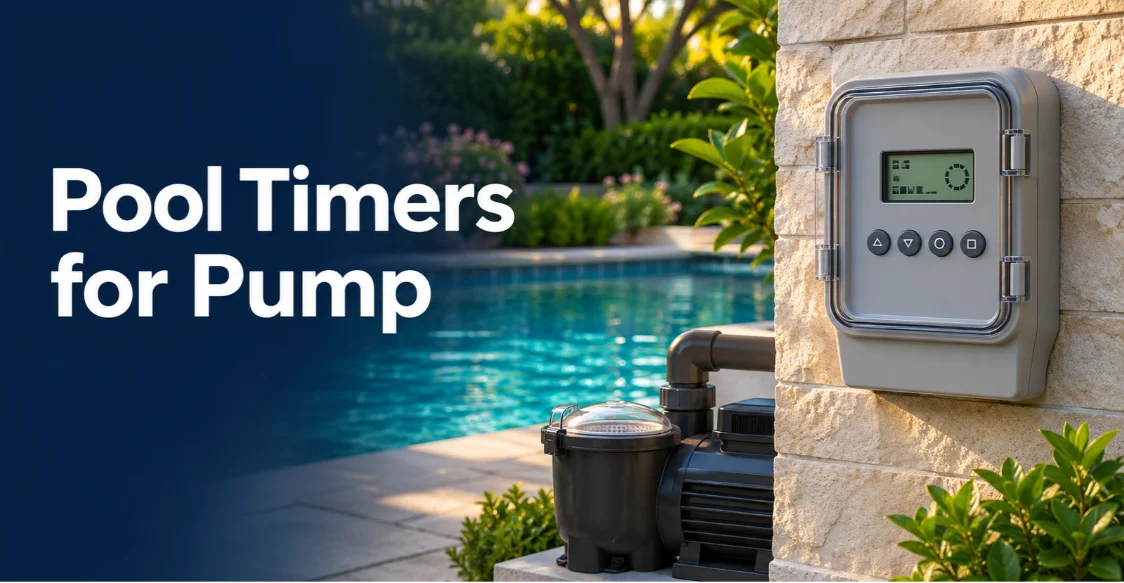
Choosing pool timers for pump control starts with your pump’s electrical requirements, not the timer’s extra features. The timer must match the circuit voltage, motor load, and installation location. After compatibility is confirmed, you can compare mechanical, digital, and Wi-Fi scheduling.
Quick answer: A good pool pump timer matches your pump’s voltage, current, motor rating, and connection type. Mechanical timers suit simple daily schedules, while digital models offer greater programming flexibility. Smart timers add app control. Outdoor equipment should use appropriately rated enclosures, and hardwired installations should be handled safely.
Pool Pump Timer Choices at a Glance
| Timer type | Best suited for | Main advantage | Main limitation |
|---|---|---|---|
| Mechanical timer | Simple daily schedules | Straightforward operation | Limited weekly scheduling |
| Digital timer | Different weekday schedules | More programming options | More setup is required. |
| Wi-Fi timer | Remote control and monitoring | App-based scheduling | Depends on compatible connectivity |
| Pump-integrated controls | Compatible modern pumps | Controls are built into equipment. | External timers may be unnecessary. |
Key Takeaways
- Match the timer to the pump’s voltage, amperage, and motor rating first.
- Confirm whether your equipment uses a plug, twist-lock connection, or hardwired circuit.
- Choose an outdoor-rated enclosure when the control sits on an exposed equipment pad.
- Mechanical timers work well for simple repeating schedules.
- Digital timers suit owners who want different schedules throughout the week.
- Wi-Fi controls make remote changes easier but add network dependence.
- Some variable-speed pumps already provide scheduling through their own controls.
- Hire a qualified electrician when the installation involves fixed electrical wiring.
What Type of Pool Timer Do You Need?
The correct timer depends first on how your pump receives power. A 120-volt plug-in pump needs different equipment than many hardwired 240-volt systems. Always read the pump nameplate before comparing timer features.
Intermatic provides a useful example of this distinction. Its T101-series options serve certain 120-volt applications, while T104 models serve 208-to-277-volt circuits. The manufacturer specifically lists T100-series mechanical switches for residential pump scheduling.
A high current rating alone does not guarantee compatibility. Motor loads can place different demands on switches than simple resistive appliances. The timer specifications should explicitly support the motor and electrical arrangement you have.
HausFixr homeowners planning larger electrical changes should also review the electrical panel upgrade guide. Adding pool equipment can affect circuit planning in some homes. A licensed electrician can determine whether an existing circuit and panel have sufficient capacity.
Pool Timers for Pump Control: Mechanical, Digital, or Smart?
Mechanical timers use a physical dial and switching mechanism to control daily operation. They remain popular because their schedules are easy to understand. They also avoid apps, Wi-Fi connections, and complicated menus.
Digital timers replace the physical dial with electronic scheduling controls. They can support weekday and weekend differences more easily. This flexibility helps homeowners whose pool use changes through the week.
Smart timers add remote control through an app or connected platform. DEWENWILS currently offers models supporting 120-to-277 VAC, 40 amps, and motor loads up to 2 HP. Certain models also use 2.4 GHz Wi-Fi and support Alexa or Google Assistant.
The extra convenience does not make a smart model automatically better. A simple mechanical unit may serve a fixed filtration schedule perfectly. Smart control matters most when you expect to change schedules often.
Comparing Common Timer Approaches
| Option | Scheduling | Remote control | Typical use | Important check |
|---|---|---|---|---|
| Intermatic T100-series mechanical | Daily repeating schedule | No | Traditional hardwired equipment | Choose the correct voltage model. |
| Heavy-duty digital timer | Daily or weekly programs | Usually no. | Owners wanting flexible schedules | Confirm motor and enclosure ratings. |
| DEWENWILS Wi-Fi heavy-duty timer | App schedules and countdowns | Yes | Remote schedule changes | Check voltage, horsepower, and Wi-Fi. |
| Built-in pump scheduler | Depends on the pump. | Sometimes | Modern compatible pumps | Confirm the external timer is necessary. |
The Intermatic mechanical approach is a strong choice for straightforward fixed schedules. Its T104R supports 208-to-277 VAC and uses an outdoor Type 3R enclosure. Intermatic also rates the model for 40-amp inductive loads within its stated specifications.
A digital timer is better when Monday should differ from Saturday. You gain scheduling flexibility without requiring cloud or Wi-Fi access. Programming can take longer initially, but daily operation remains automatic afterward.
A heavy-duty Wi-Fi unit suits owners who want remote changes. DEWENWILS lists app scheduling, countdown operation, and voice assistant support on current models. Buyers should still verify that the exact model matches their pump before purchasing.
Mechanical Timer Pros and Cons
Pros
- Simple controls
- No Wi-Fi connection required
- Easy manual override on many models
- Suitable for predictable schedules
Cons
- Limited schedule variation
- Manual resetting may be needed after some interruptions
- No remote app control
Digital Timer Pros and Cons
Pros
- Flexible daily or weekly programming
- Multiple switching events may be available
- Useful for changing seasonal schedules
- No smartphone is required on standard models
Cons
- More setup steps
- Controls vary between manufacturers
- Electronics add complexity compared with basic mechanical switches
Smart Timer Pros and Cons
Pros
- Remote schedule changes
- App-based control
- Countdown functions on many models
- Useful when equipment access is inconvenient
Cons
- Wi-Fi compatibility matters
- Setup can be more involved
- App support may vary by manufacturer
- Electrical compatibility still takes priority over smart features
Seven Things to Check Before Buying
1. Confirm the Pump Voltage
Read the motor nameplate rather than guessing from the plug or equipment size. Pool pumps commonly use different residential circuit arrangements. The timer must support the voltage supplied to that pump.
2. Check Amperage and Motor Ratings
Timer marketing often highlights an amp number prominently. That number should not be your only compatibility check. Confirm the manufacturer’s stated motor or horsepower limits too.
3. Identify the Connection Type
Some above-ground equipment uses plug-in connections. Larger equipment may use twist-lock receptacles or fixed wiring. Buy a timer designed for the connection already serving the pump.
4. Choose the Correct Outdoor Rating
Pool equipment often sits outside throughout the year. Rain, humidity, dust, heat, and freezing conditions can affect electrical controls. Use equipment designed for its actual installation environment.
5. Decide How Much Scheduling You Need
A daily mechanical schedule is enough for many homeowners. Different weekday programs may justify a digital timer. Frequent remote adjustments can make a Wi-Fi model more convenient.
6. Check Whether the Pump Already Has Scheduling
Some newer pumps provide their own programming features. Adding another control could complicate operation unnecessarily. Review the pump manual before buying an external timer.
7. Plan for Safe Installation
Plug-in timers can be simpler when they are specifically designed for the equipment involved. Hardwired pool controls introduce greater electrical risk. Use qualified professional help when fixed wiring or circuit changes are required.
If your project is part of a larger backyard upgrade, HausFixr’s luxury pool design guide explains broader equipment planning. Owners comparing major upgrades can also consider pool remodeling versus replacement.
How Long Should a Pool Pump Run on a Timer?
There is no single daily runtime that fits every residential pool. As a rough range, many single-speed pumps run about 6 to 10 hours a day in swimming season, while variable-speed pumps often run longer at lower speeds, around 8 to 14 hours. Pool volume, pump flow, debris load, sanitation, weather, and equipment design can change the requirement. The goal is adequate circulation without unnecessary operating time.
Some guidance uses water turnover as a starting point. Federal rulemaking discussions have also examined timers as a way to prevent unnecessary pump operation. Those discussions recognized that many residential systems do not require continuous 24-hour operation.
Avoid setting the schedule solely because another homeowner runs eight hours daily. Your system may need more or less time. Monitor water quality and follow the equipment manufacturer’s recommendations.
A variable-speed pump changes this calculation further. Lower-speed operation may run longer while still using less power than high-speed operation. Use the pump’s own programming guidance when its controller manages speed and schedule together.
When Is a Smart Pool Pump Timer Worth It?
Smart control is useful when schedules change often. Vacation homes and frequently adjusted equipment are good examples. Remote access also helps when the equipment pad is hard to reach. You do not need Wi-Fi control for basic filtration automation. A properly matched mechanical timer can handle a simple repeating schedule.
The better choice depends on convenience needs rather than technology alone. Smart features should remain secondary to electrical compatibility. A timer with an attractive app is useless when its motor rating is wrong. Start with the pump nameplate, then compare control features.
Installation and Electrical Safety
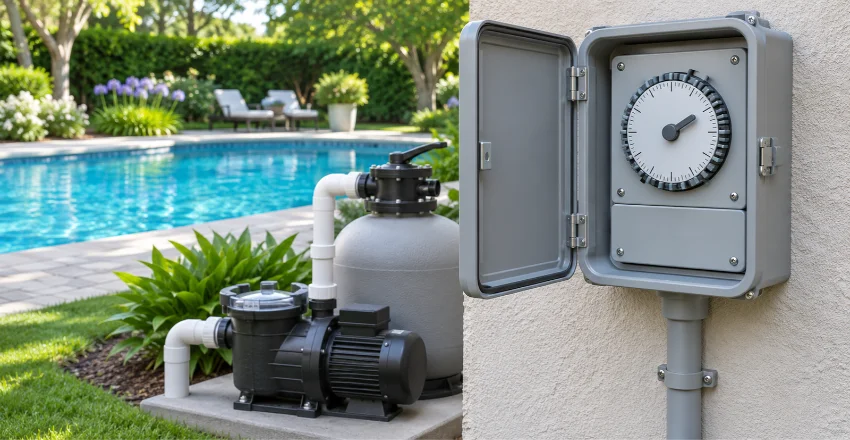
Pool equipment combines electricity, water, and outdoor exposure. That combination makes correct equipment selection especially important. Never treat a household indoor smart plug as a substitute for a properly rated pool control.
Fixed electrical work may also involve local code requirements and inspection rules. Requirements differ between jurisdictions, so verify them before installation. A licensed electrician can also check GFCI protection, grounding, bonding, overcurrent protection, and circuit suitability, and can tell you whether a permit is required. For a hard-wired 240-volt installation, hire a licensed electrician rather than attempting the wiring yourself.
Do not increase breaker size to make an undersized circuit support a larger pump. The breaker and wiring must be coordinated with the connected equipment. HausFixr’s electrical planning information can help you identify questions for an electrician before work begins.
Our Recommendation
For a basic hardwired system with the same schedule every day, choose a properly matched mechanical timer. Intermatic’s T100 family illustrates this traditional approach well. Select the exact model by voltage and installation environment.
Choose a digital timer when your weekly schedule changes regularly. It provides more control without requiring Wi-Fi. This option can suit seasonal schedules and different weekday routines. Choose a heavy-duty Wi-Fi timer when remote adjustments are genuinely useful.
Confirm voltage, amperage, motor rating, enclosure rating, and network requirements before buying. App functions should come after those essential specifications.
Frequently Asked Questions
What are the best pool timers for pump control?
The best choice is the timer that correctly matches your pump and circuit. Mechanical models suit simple schedules, while digital models add weekly programming. Wi-Fi timers are useful when remote control matters.
Can I use a regular outlet timer for a pool pump?
Only use a timer specifically rated for the pump’s electrical load and installation environment. Motor loads can exceed the capabilities of ordinary household outlet timers. Outdoor exposure also requires suitable equipment protection.
Is a mechanical or digital pool timer better?
Mechanical timers are simpler and work well for repeating schedules. Digital timers provide more flexible programming throughout the week. Neither type is universally better for every installation.
Can a smart plug control a pool pump?
A generic indoor smart plug is not an appropriate choice for most pool equipment. Any device must match the pump’s voltage, motor load, and environmental requirements. Purpose-built heavy-duty smart controls are safer candidates when specifications match.
Do variable-speed pool pumps need external timers?
Many variable-speed pumps have built-in scheduling controls. Check the manufacturer’s manual before adding another timer. An external control may be unnecessary or incompatible with the intended operating system.
How many hours should I schedule my pool pump?
Runtime depends on pool size, pump performance, water conditions, and treatment needs. Start with manufacturer guidance and your system’s circulation requirements. Adjust the schedule while monitoring water clarity and sanitation.
Choosing Your Timer
Start by photographing the pump nameplate and existing electrical connection. Record voltage, amperage, horsepower, and the current control arrangement. Those details will eliminate incompatible timer choices quickly.
Next, decide whether you need a repeating daily schedule, weekly programming, or remote access. Then confirm the chosen timer’s outdoor and motor ratings. This order prevents convenience features from distracting you from basic compatibility.
For hardwired equipment, have a qualified professional confirm the final selection and installation. A correctly matched timer can automate filtration without running equipment unnecessarily. It can also make daily pool ownership simpler and more predictable.