
Moving a manufactured home can cost far more than hiring a standard household mover. If you’re asking how much it costs to move a mobile home, the biggest question is whether your quote covers transportation alone or the entire relocation.
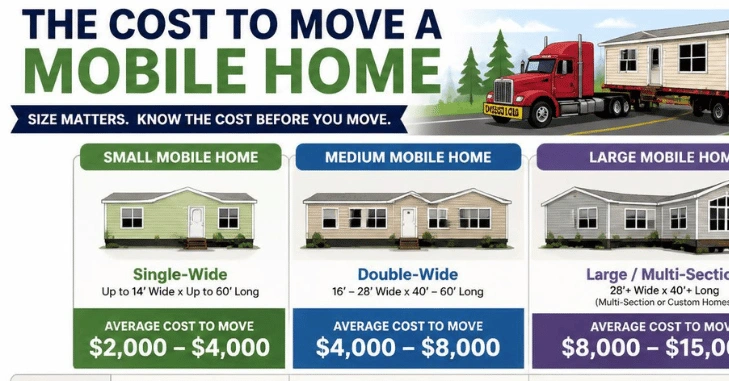
In 2026, a full-service move typically costs about $5,000–$8,000 for a single-wide, $8,000–$15,000 for a double-wide, and $12,000–$20,000 or more for a triple-wide. Transport-only service can range from about $1,000 to $5,000. Distance, permits, escorts, disconnection, and setup can raise the final bill.
| Home type or service | Typical 2026 cost | What to know |
| Single-wide, full service | $5,000–$8,000 | One section makes transport simpler. |
| Double-wide, full service | $8,000–$15,000 | Two sections must be separated and rejoined. |
| Triple-wide, full service | $12,000–$20,000+ | Multiple loads increase labor and transportation needs. |
| Transportation only | About $1,000–$5,000 | Setup, utilities, and site work may be separate. |
| Local single-wide, up to about 50 miles | Often $5,000–$8,000 | The route and service level can change the quote |
| Local double-wide, up to about 50 miles | Often $10,000–$13,000 | Reassembly adds labor. |
Published estimates vary because companies and cost guides don’t always include the same services. This Old House reports average full-service costs of about $6,500 for a single-wide and $11,500 for a double-wide. HomeGuide places typical full-service ranges at $5,000–$8,000 and $8,000–$15,000, respectively.
Key takeaway: Don’t compare two relocation quotes until you know whether both include permits, preparation, transportation, escorts, utility work, leveling, anchoring, reassembly, and final setup.
How Much Does It Cost to Move a Mobile Home by Size?

Width matters because wider manufactured homes require more equipment, labor, and coordination. A single-wide normally travels as one section. That keeps dismantling and reassembly costs lower than they would be for a multi-section unit. Current cost guides commonly place full-service relocation in the $5,000–$8,000 range.
A double-wide normally must be separated into two sections for transportation. Each section then travels separately and must be rejoined at the destination. That helps explain why published full-service prices commonly range from $8,000 to $15,000.
How much does it cost to move a mobile home? Triple-wide homes require another transport section and more setup work. HomeGuide estimates full-service costs at roughly $12,000–$20,000 or more. Other current moving-cost estimates indicate that complex triple-wide moves can exceed $20,000.
Transport-Only vs. Full-Service Pricing

One of the easiest ways to underestimate your budget is to compare a transport-only estimate with a full-service estimate.
Transport-only service generally focuses on moving a prepared home from one location to another. Depending on the contract, the homeowner may need to arrange disconnection, removal of exterior features, utility work, and setup separately.
Full-service relocation can include preparation, transportation, disconnection, reconnection, and setup. Current estimates place transportation-only service at roughly $1,000–$5,000, while full-service moves cost considerably more once preparation and setup are included.
Ask each company to list its exclusions in writing. A low headline price loses its advantage if several thousand dollars in required work appears on separate invoices later.
What Makes the Price Go Up?
Several variables can change the final relocation bill.
Distance and Route
Longer trips require more fuel and labor, but mileage isn’t the only concern. Narrow roads, low clearances, bridge restrictions, difficult turns, and approved-route requirements can make a relatively short trip expensive.
For moves of around 50 miles, current estimates often place the cost of moving a single-wide at $5,000–$8,000 and a double-wide at $10,000–$13,000. Difficult routes can push those figures higher.
Permits and Escort Vehicles
Oversize transportation can require permits and pilot vehicles, depending on the load and jurisdiction. Escort vehicles may add mileage-based charges, while permit requirements and fees vary by location. Ask whether the mover obtains the necessary permits or expects you to handle them.
Preparation and Disassembly
Decks, porches, skirting, awnings, utility connections, and other additions may need to be removed before transportation.
Multi-section homes must be separated before leaving the property. More preparation means more crew hours and higher labor costs.
Setup at the Destination
The structure must do more than arrive safely. It also needs proper positioning, leveling, anchoring, utility connections, and reassembly when applicable.
HUD maintains Model Manufactured Home Installation Standards under 24 CFR Part 3285. State installation programs may also have requirements that meet or exceed federal standards.
If your relocation is part of a larger property project, HausFixr’s guide to what home builders specialize in can help you think through permits, scheduling, inspections, and contractor coordination.
Condition of the Structure
Age by itself doesn’t determine whether a unit can travel safely. Frame condition, roof problems, water damage, weakened flooring, and previous alterations may matter more.
A mover may inspect an older structure before accepting the job. Structural repairs can increase costs or make relocation impractical.
A Better Way to Compare Moving Quotes

Consider two fictional estimates for the same relocation.
| Quote item | Mover A | Mover B |
| Transportation | $5,500 | Included |
| Preparation | $1,500 | Included |
| Permits | $500 | Included |
| Escort vehicle | $400 | Included |
| Setup and leveling | $2,000 | Included |
| Utility coordination | $900 | Included |
| Estimated total | $10,800 | $9,800 |
Mover A appears cheaper when you look only at the $5,500 transportation charge. Once the excluded services are added, Mover B becomes the less expensive option.
This example isn’t a national price estimate. It shows why scope matters more than the headline number.
When requesting bids, ask each company to price the same items:
- home preparation and disassembly
- transportation mileage
- permits
- pilot or escort vehicles
- insurance responsibilities
- utility disconnection and reconnection
- leveling and anchoring
- section reassembly
- skirting or exterior work
- cleanup and debris removal
If site work continues after the relocation, HausFixr’s exterior home resources can help you plan later repairs and exterior projects.
For landscaping around the finished site, the site’s gravel walkway guide also explains drainage, compacted bases, and finished-path costs. It isn’t intended as a guide for creating a transportation route or structural pad.
Is Moving an Older Home Worth the Cost?
Start with three numbers: the relocation quote, the cost of any repairs required before transportation, and the cost of buying a comparable unit at the destination.
Moving can make financial sense when the structure is in good condition, and the destination isn’t far away. The calculation becomes less attractive when a multi-section home needs structural repairs, extensive site work, or a long interstate haul.
Some long-distance relocations exceed $20,000, especially for larger homes and complex routes. If the home’s condition is uncertain, have the structure inspected before paying nonrefundable deposits.
How to Keep the Relocation Cost Under Control
Start by getting several itemized quotes rather than comparing one-line estimates. Give every contractor the same information: the home’s width, number of sections, approximate dimensions, origin, destination, distance, attachments, current foundation or support system, and condition of the destination site.
Then ask three questions:
- What does this price exclude?
- Which charges can change after work begins?
- Who pays if the route or site requires additional work?
A precise quote isn’t necessarily the lowest quote. It’s the quote that makes it easiest to understand what you’ll owe.
Get the Full Price Before You Commit
A national average is useful for early planning, but your route and the scope of work determine the real bill. Before hiring a mobile home mover, request at least two or three itemized estimates. Make sure each contractor prices the same preparation, transportation, permit, setup, and utility tasks. That comparison gives you a budget you can use, rather than a low transportation price that increases after the work begins.
Conclusion
How much does it cost to move a mobile home? Moving a mobile home can be significantly more complicated than relocating an ordinary household because the structure must be prepared, transported, and set up safely at the new property. The total cost depends on factors such as the home’s size, moving distance, route conditions, permits, utility disconnections, foundation requirements, labor, and whether additional site preparation is needed.
Before hiring a mover, get a detailed written estimate that separates transportation from permits, setup, utility work, and other potential charges. Planning these expenses in advance can help prevent unexpected costs and make the relocation process smoother.
Frequently Asked Questions
For many local moves in 2026, published estimates place a single-wide at around $5,000–$8,000 and a double-wide at around $10,000–$13,000. Route restrictions, permits, escorts, preparation, and destination setup can push the price outside those ranges.
Current estimates place the average full-service price at about $6,500, with a broader typical range of approximately $5,000–$8,000.
Possibly. A qualified mover will need to consider the home’s structural condition, frame integrity, modifications, and local requirements. Homes with substantial deterioration may need repairs before transportation or may not be suitable candidates for relocation.
Sometimes. Some movers include permit handling in a full-service bid, while others bill for it separately. Ask for a written list of included permits and any possible escort charges before signing.
It depends on the home’s condition, size, transportation distance, required site work, and the price of a replacement at the destination. Get a complete relocation estimate first, then compare it with the realistic cost of replacing the structure.